


Best Automation Courses in Egypt | PLC, SCADA & Industrial Automation
Best Automation Courses in Egypt: What Should You Learn?
Industrial automation is becoming an increasingly important part of modern manufacturing in Egypt. As factories adopt PLC-based control systems, HMI, SCADA, industrial networks, drives, and advanced instrumentation, engineers and technicians need practical skills that go beyond electrical theory.
But if you are searching for the best automation courses in Egypt, there is an important question to answer first:
What should you actually learn to become a job-ready Automation Engineer?
The answer is not one software package or one PLC course. A strong industrial automation learning path should combine electrical control fundamentals, PLC programming, HMI and SCADA, drives, industrial networking, instrumentation, and practical troubleshooting.
Here is what you should look for.
- To start, focus on Classic Control and Motor Control.
Before learning PLC programming, it is important to understand how industrial control circuits work.
Furthermore, a good automation course should introduce you to:
In addition, contactors and relays
• Overload protection
• Motor starters
• Forward/Reverse motor control
• Star-Delta starting
• Control circuit wiring
• Motor protection
• Basic troubleshooting
Understanding these circuits gives you a solid foundation for PLC programming because you will understand what the PLC is actually controlling.
For engineers and fresh graduates, Classic Control is often an excellent starting point before moving into PLC and industrial automation.
- Learn PLC Programming
PLC programming is one of the core skills in industrial automation.
When comparing PLC courses in Egypt, look for practical training that covers both programming concepts and real hardware.
Additionally, important topics include:
As a further topic, PLC architecture is included.
Moreover, digital and analog inputs and outputs are included.
• Ladder Logic (LAD)
• Function Block Diagram (FBD)
• Timers and counters
• Data handling
• Hardware configuration
• PLC troubleshooting
• Online monitoring and debugging
• PLC-to-device communication
PLC systems are particularly important to understand for engineers targeting many manufacturing and industrial applications in Egypt, while knowledge of other platforms can also be valuable depending on the industry and employer.
If you are starting from scratch, learning one major PLC platform properly is usually more useful than trying to learn several platforms superficially.
- Learn TIA Portal
If your goal is to work with Siemens automation systems, TIA Portal should be an important part of your learning path.
A practical PLC course should cover areas such as:
• S7-1200
• S7-1500
• TIA Portal
• System hardware setup
Automation of PLC programming.
• Integration of HMI
• Troubleshooting
• Industrial communication
The important point is not simply knowing how to open the software.
You should be able to build, test, monitor, and troubleshoot a PLC application.
- HMI and SCADA
PLC programming is only part of an automation system.
Operators need to monitor machines, change parameters, acknowledge alarms, view process information, and understand what is happening inside the plant.
This is where HMI and SCADA become important.
A good automation training program should explain:
HMI
• Interface design for screens
Tag labels
• Buttons and controls
• Alarms
• Trends
• PLC-HMI communication
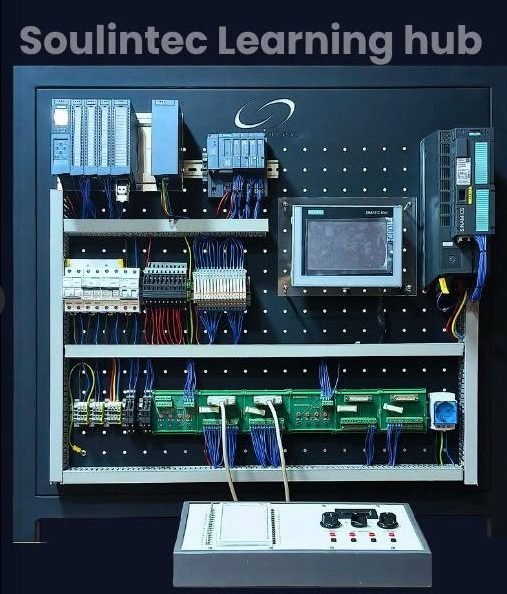
SCADA
• SCADA architecture
• Tags and data acquisition
• Alarms
• Trends
• Historical data
• PLC communication
• Industrial visualization
For Siemens-based systems, technologies such as WinCC can be particularly useful to learn.
Understanding how PLC + HMI + SCADA work together gives you a much broader understanding of industrial automation.
- Learn VFDs and Motor Drives
Automation engineers frequently work with electric motors and variable-speed applications.
A practical course should therefore include Variable Frequency Drives (VFDs).
Furthermore, you should learn how to:
• Understand VFD operation
• Select basic parameters
• Configure motor data
• Set acceleration and deceleration
• Control motor speed
• Use digital and analog signals
• Interface a VFD with a PLC
• Diagnose common drive faults
Depending on the industrial environment, engineers may encounter different drive manufacturers and platforms.
The goal is to understand the principles of drive commissioning and PLC integration rather than memorizing one manufacturer’s parameters.
- Industrial Networking
Modern automation systems rely heavily on communication between controllers, HMI, drives, remote I/O, and other industrial devices.
An automation course should introduce you to industrial communication concepts and commonly used protocols such as:
• PROFINET
• PROFIBUS
• Mod-bus
• Ethernet-based industrial communication
You should understand how devices communicate and how to diagnose basic communication problems.
This becomes particularly important as automation systems become more connected and distributed.
- Industrial Electrical Wiring and Control Panels
Programming alone does not make an automation engineer.
You should also understand how the electrical hardware is assembled and connected.
Useful skills include:
• Reading electrical drawings
Circuit wiring for control systems.
Details of PLC I/O wiring
• Terminal blocks
• Sensors and actuators
• Control panel components
• Panel layout
• Electrical schematics
• Cable identification
• Troubleshooting wiring faults
Hands-on control panel and wiring training can make the transition from engineering theory to industrial practice much easier.
- Instrumentation and Calibration
If you want to work in process industries, instrumentation is another important area to consider.
You should understand the basics of:
• Pressure measurement
• Temperature measurement
• Level measurement
• Flow measurement
• Sensors and transmitters
• 4–20 mA signals
• Analog signals
• Instrument calibration
• PLC integration
Instrumentation becomes especially valuable when automation systems interact with real industrial processes.
Which Automation Course Should You Start With?
There is no single best automation course for everyone.
Your starting point should depend on your background and career goal.
Electrical Engineering Student:
Classic Control + Industrial Wiring
Fresh Electrical Graduate:
Classic Control → PLC → HMI/SCADA
Mechatronics Graduate:
PLC → HMI/SCADA → Industrial Networking
Maintenance Engineer:
Classic Control → PLC → VFD
Control Engineer:
PLC → HMI/SCADA → Networking
Instrumentation Engineer:
Instrumentation → PLC → SCADA
Engineer with PLC Experience:
Advanced PLC → HMI/SCADA → Networking
Technician:
Electrical Wiring → Classic Control → PLC
The most important thing is to build your skills progressively rather than trying to learn everything at once.
What Makes a Good Automation Course in Egypt?
When comparing automation training centers, don’t choose a course based only on the number of topics listed in the brochure.
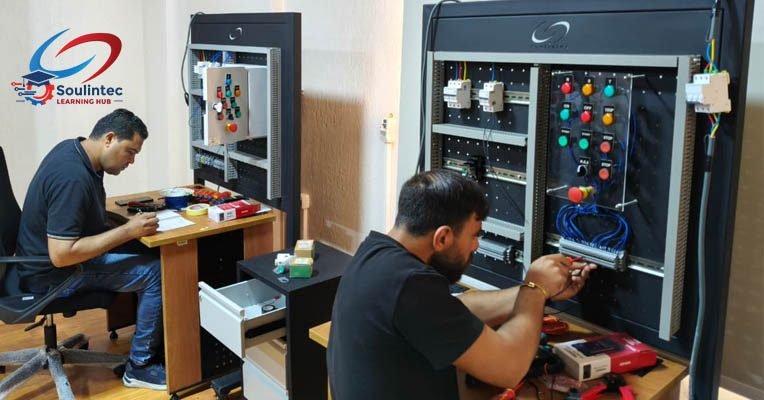
Ask these questions:
Is the training hands-on?
Will you work with actual PLCs, control panels, motors, drives, sensors, and industrial equipment?
Will you troubleshoot real problems?
Automation engineers need to diagnose faults, not only write programs.
Which PLC platform is used?
Ask whether the course uses Siemens, Allen-Bradley, or another industrial platform.
Will you work with HMI and SCADA?
A complete automation path should connect PLC programming with operator interfaces and supervisory systems.
Will you learn electrical control?
Understanding contactors, relays, motors, protection, and wiring is extremely valuable.
Will you build or wire anything?
Practical wiring and panel-building experience can make a significant difference for fresh graduates.
Is there a clear learning path?
A good program should explain what you should learn first, what comes next, and how the different technologies connect.
Why Hands-On Training Matters
One of the biggest differences between learning automation theoretically and learning it practically is troubleshooting.
In a real industrial environment, the system may not work perfectly.
A sensor may fail.
A motor may not start.
A PLC input may not change state.
A VFD may report a fault.
A communication connection may be lost.
An engineer needs to understand the entire system and identify the cause of the problem.
This is why practical training with industrial hardware can be extremely valuable, especially for students and fresh graduates who have limited industrial exposure.
Soulintec Learning Hub – Industrial Automation Training in Egypt
Soulintec Learning Hub provides practical engineering and industrial automation training in Egypt, with courses covering areas such as:
• Classic Control
• PLC Programming
• SCADA Systems
• Industrial Wiring
• Control Panel Building
• Instrumentation
• Industrial Automation
The training path is designed to connect electrical fundamentals with modern industrial automation technologies.
For learners who want to develop practical automation skills, the key advantage to look for is the opportunity to work with real equipment, perform wiring and configuration, practice programming, and troubleshoot industrial control systems.
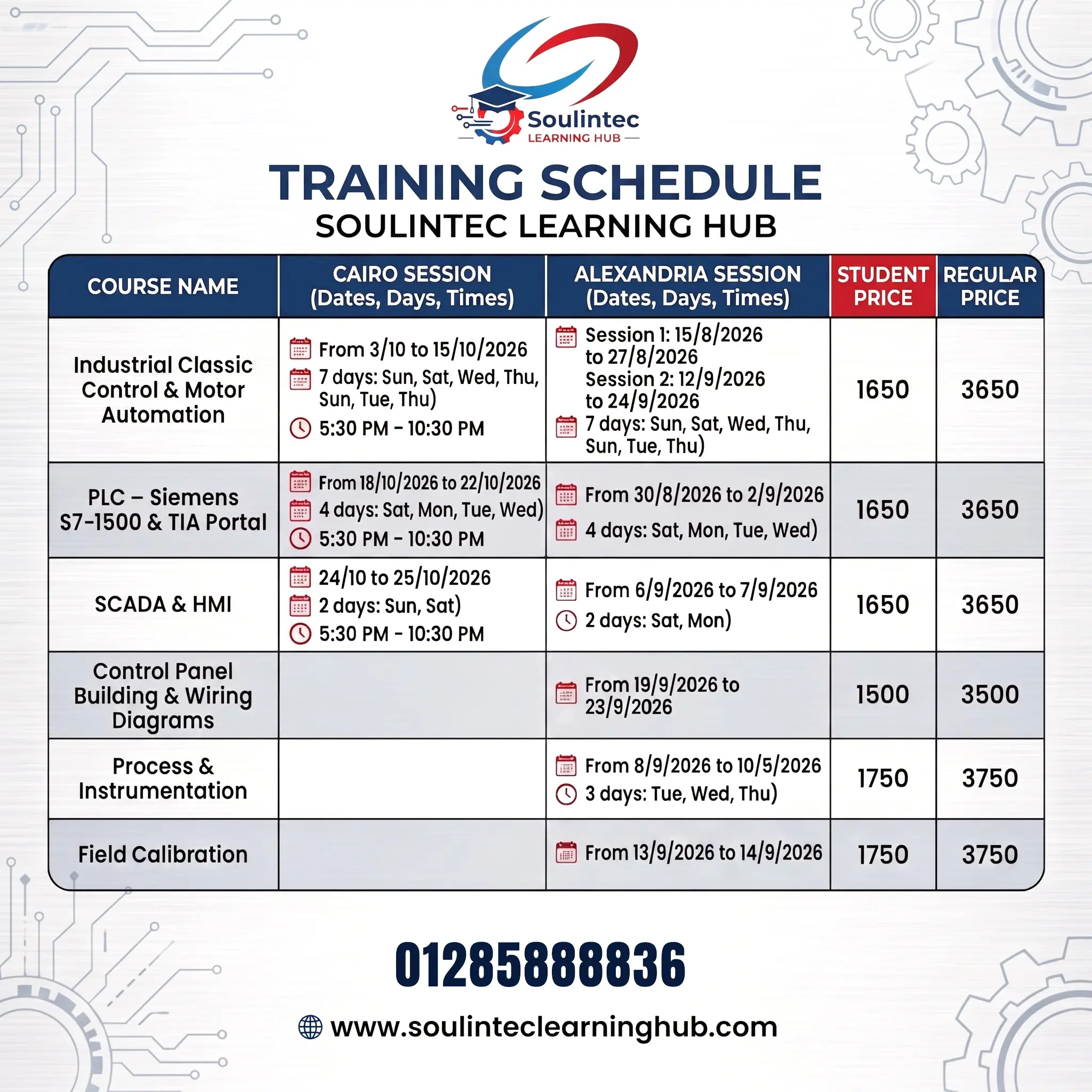
You can explore the available training programs and upcoming schedules through the Soulintec Learning Hub website.
A Practical Automation Learning Path
If your goal is to become an Automation Engineer, a practical learning sequence can look like this:
Step 1 — Electrical Fundamentals
↓
Step 2 — Classic Control & Motor Control
↓
Step 3 — Industrial Wiring & Control Panels
↓
Step 4 — PLC Programming
↓
Step 5 — HMI
↓
Step 6 — SCADA
↓
Step 7 — VFDs & Motor Drives
↓
Step 8 — Industrial Networking
↓
Step 9 — Instrumentation
↓
Step 10 — Practical Projects & Troubleshooting
This approach gives you a broader understanding of how an industrial automation system works as a complete system rather than treating each technology separately.
Frequently Asked Questions
What is the best automation course in Egypt?
There is no single course that is best for everyone. A strong automation learning path should cover practical electrical control, PLC programming, HMI/SCADA, drives, industrial networking, and troubleshooting.
Which course should I take first: PLC or Classic Control?
For beginners with limited electrical control experience, Classic Control is a useful foundation before PLC programming. Engineers who already understand motor control circuits can start directly with PLC training.
Is PLC enough to become an Automation Engineer?
PLC programming is an essential skill, but it is usually not enough by itself. Automation engineers also benefit from knowledge of electrical control, HMI, SCADA, drives, industrial networking, instrumentation, and troubleshooting.
Should fresh graduates learn PLC?
Yes. PLC programming can be a valuable skill for electrical, mechatronics, control, and automation graduates, especially when combined with practical electrical and industrial training.
Is hands-on automation training important?
Yes. Practical experience helps learners understand wiring, commissioning, troubleshooting, and the relationship between PLC software and real industrial equipment.
What should I learn after PLC?
A logical next step is HMI and SCADA, followed by industrial networking, VFDs, instrumentation, and more advanced troubleshooting depending on your career path.
Start Your Industrial Automation Journey
Choosing an automation course is not simply about learning software.
The goal is to develop the ability to understand an industrial system, program it, connect its components, operate it, and troubleshoot it.
If you are looking for practical industrial automation training in Egypt, start by comparing the curriculum, equipment, hands-on activities, instructors, and learning path before choosing a course.
Explore Soulintec Learning Hub’s automation and engineering training programs and find the course that matches your career goals.
Enroll in the PLC Programming & Industrial Automation Hands-On Course:
For enrollment and course details:
Soulintec Learning Hub