



Critical Difference Between PLC and SCADA
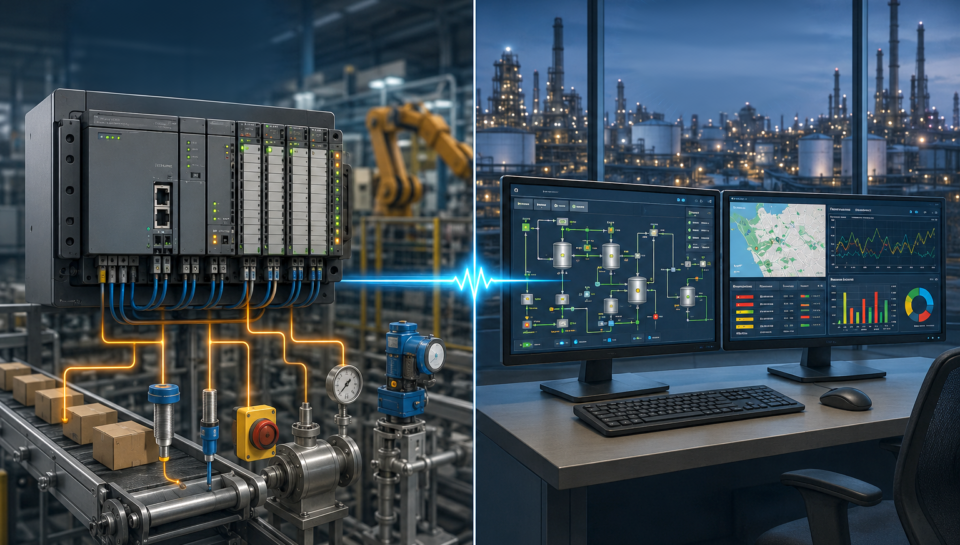
Brains and Eyes: Understanding the Critical Difference Between PLC and SCADA
In the world of industrial automation, two acronyms dominate the conversation: PLC and SCADA. For outsiders, these terms are often thrown around interchangeably. For engineers, they represent two distinct, interdependent pillars of modern manufacturing and infrastructure.
If you’ve ever watched a bottling plant, a water treatment facility, or an oil refinery in operation, you have witnessed a ballet of PLCs and SCADA systems working in harmony. But what exactly is the difference?
The simplest way to understand it is this: The PLC is the brain, and SCADA is the eyes and dashboard.
What is a PLC? (The Brawn and the Brains)
PLC stands for Programmable Logic Controller.
Physically, a PLC is a ruggedized, industrial computer. It sits inside a control cabinet on the factory floor, often in dusty, hot, or wet conditions. Its job is to make real-time decisions based on hardwired inputs and outputs (I/O).
- How it works: A PLC reads sensors (“Is the tank full?”) and runs a user-written program to instantly change outputs (“Turn off the inlet valve”).
- Speed: Millisecond or even microsecond response times.
- Autonomy: A PLC does not need a human or a computer to work. Once programmed, it runs the machine forever by itself.
Think of a PLC as a traffic cop. It stands at the intersection, looks at the cars (inputs), and immediately changes the lights (outputs) based on a strict rulebook.
What is SCADA? (The Dashboard and Historian)
SCADA stands for Supervisory Control and Data Acquisition.
SCADA is not a single box; it is a software system that runs on standard computers. Its job is to aggregate data from hundreds or thousands of PLCs across a large geographic area and present it to a human operator.
- How it works: The SCADA system talks to PLCs, reads their data, logs it into a database, draws animated graphics on a screen, and sends high-level commands.
- Scope: Unlimited. SCADA can monitor a single building or an entire national pipeline network.
- Alarming: SCADA doesn’t stop a machine; it alerts a human when a machine stops itself.
Think of SCADA as a traffic management center. It watches a giant map of all intersections and allows a supervisor to override the system during a traffic jam.
The Key Differences at a Glance
| Feature | PLC | SCADA |
|---|---|---|
| Type | Hardware (physical controller) | Software (application & server) |
| Primary Job | Control logic & I/O management | Visualization, logging, & alarming |
| Response Time | Real-time (milliseconds) | Human-time (seconds to minutes) |
| Autonomy | Runs independently without a PC | Useless without the PLC data |
Do You Need Both?
The answer depends on the complexity of your operation.
- One Machine (e.g., a pallet wrapper): You just need a PLC with a small touchscreen HMI.
- One Factory (e.g., a car assembly line): You need both. You need a SCADA system to watch all 50 PLCs at once.
- Five Wells in a 50-mile radius (e.g., oil & gas): You absolutely need SCADA to bring all five PLCs to a single laptop screen.
The Great Misconception
A common confusion arises because many PLCs today come with built-in web servers. You can look at a single PLC’s status without buying SCADA software. But “looking” is not “Acquiring.” A PLC’s built-in web page is a snapshot. A SCADA system records a history. When the plant manager asks, “Why did Line 3 stop at 2:15 AM last Tuesday?” the PLC has no memory of that. The SCADA database does.
The Bottom Line
Use a PLC when you need speed, reliability, and direct control of physical machinery.
Use SCADA when you need to see the big picture, log data for analysis, or supervise multiple machines from a single chair.
They are not rivals. They are partners. The PLC survives the explosion on the factory floor; the SCADA tells the boss why the explosion happened.