


Certified Instrumentation & Calibration Engineer
What Does It Take to Become a Certified Instrumentation & Calibration Engineer?
A complete roadmap from education to certification in a high-demand industrial field.
In the world of industrial automation, manufacturing, and process control, accuracy is everything. A temperature sensor that reads 2 degrees too high can ruin a pharmaceutical batch. A pressure transmitter that drifts out of spec can cause a pipeline failure. The person responsible for ensuring these instruments are accurate, reliable, and trustworthy is the Instrumentation and Calibration Engineer.
But what does it actually take to become one? And more importantly, how do you get certified? This article lays out the complete path — from education to experience to passing the exam.
1. Understanding the Role: What Does an Instrumentation and Calibration Engineer Actually Do?
Before pursuing certification, you must understand the job. This is not a purely theoretical role. It is hands-on, methodical, and critical to safety and quality.
- Selecting instruments: Choosing the right sensor, transmitter, or gauge for a specific application (pressure, temperature, flow, level).
- Installing and configuring: Setting up instruments correctly and programming parameters like range, units, and output signals (4-20 mA, HART, Foundation Fieldbus).
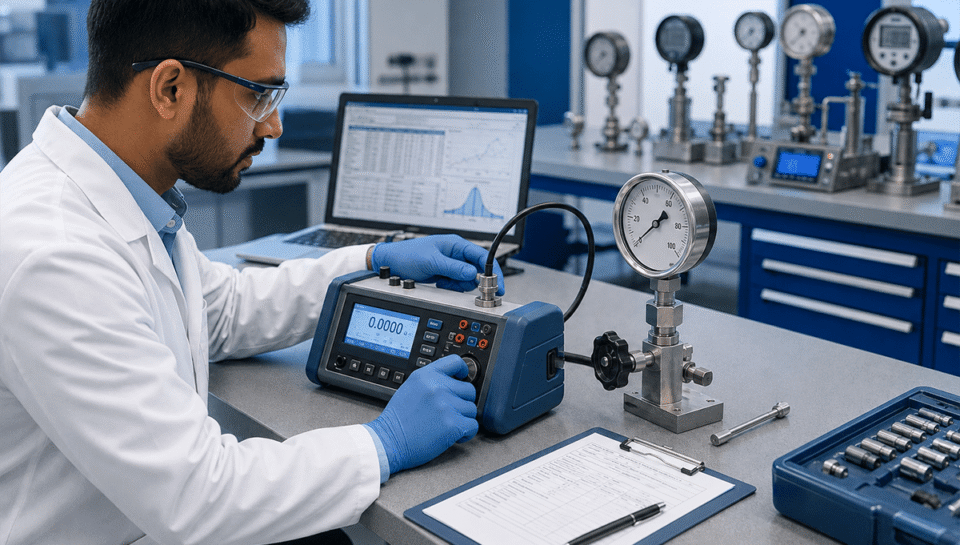
- Performing calibrations: Comparing instrument readings against traceable reference standards and adjusting for accuracy.
- Managing calibration schedules: Ensuring instruments are recalibrated at appropriate intervals based on drift, criticality, and regulations.
- Troubleshooting: Diagnosing why an instrument is reading incorrectly or has failed.
- Documenting and certifying: Producing calibration certificates, maintaining traceability, and complying with standards like ISO 9001, ISO 17025, or FDA 21 CFR Part 11.
In short: You make sure measurement devices tell the truth.
2. Education: Where Do You Start?
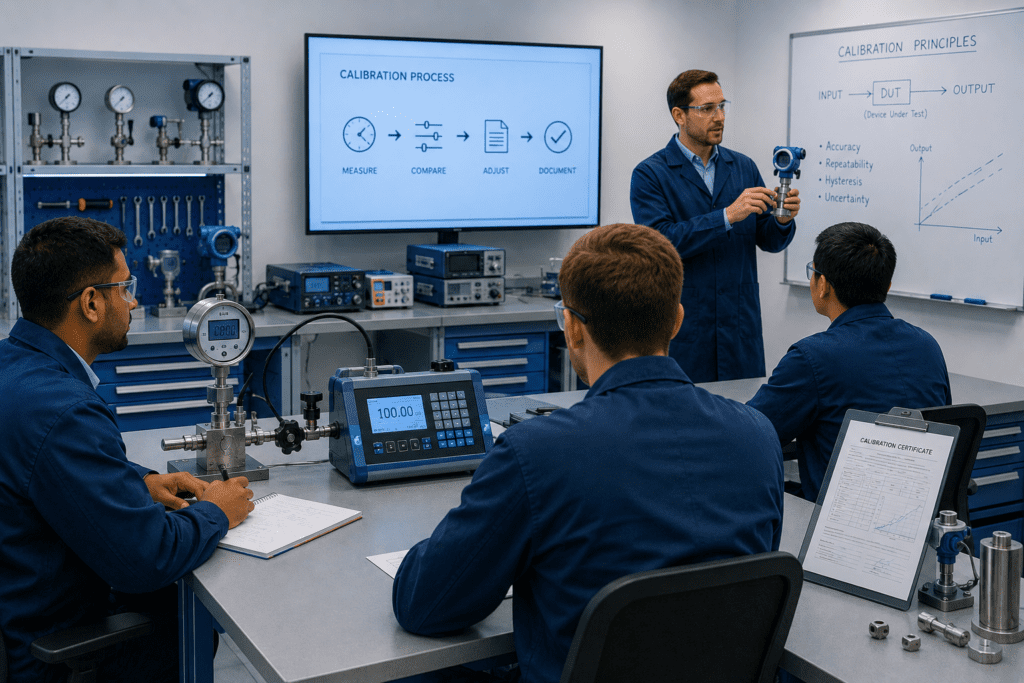
There is no single degree that guarantees certification, but certain educational paths are strongly preferred. Here are the most common routes:
| Education Level | Typical Fields of Study | Notes |
|---|---|---|
| Associate Degree (2 years) | Instrumentation Technology, Industrial Automation, Electronics | Often sufficient for technician-level roles; can lead to engineer title with experience |
| Bachelor’s Degree (4 years) | Instrumentation Engineering, Electrical Engineering, Mechanical Engineering, Control Systems Engineering | Preferred for formal engineer titles and most certification programs |
| Master’s Degree (optional) | Process Control, Metrology, Automation Engineering | Useful for senior roles, R&D, or laboratory management |
Key subjects to focus on during your studies:
- Measurement theory and uncertainty analysis
- Analog and digital electronics
- Industrial sensors and transmitters
- Control loop fundamentals (PID, open loop vs closed loop)
- Communication protocols (4-20 mA, HART, Modbus, Profibus)
- Statistical process control and metrology
3. Work Experience: The Non-Negotiable Requirement
Certification bodies almost always require documented, hands-on experience. You cannot become certified directly out of school. The typical requirement is 2 to 5 years of relevant work experience.
What counts as relevant experience?
- Performing calibrations on pressure, temperature, flow, or level instruments
- Working in an ISO 17025 accredited calibration laboratory
- Programming or configuring smart instruments (HART communicators, device configuration software)
- Troubleshooting instrument loops in a plant or factory setting
- Developing or maintaining calibration management systems or databases
- Writing calibration procedures or uncertainty budgets
Where to gain this experience:
- Oil and gas refineries or pipelines
- Pharmaceutical or biotech manufacturing
- Water and wastewater treatment plants
- Power generation facilities (nuclear, coal, gas, hydro, solar)
- Food and beverage production
- Third-party calibration service providers
- Military or aerospace instrumentation roles
4. Certification Options: Which One Should You Pursue?
There is no single global certification. Different industries and regions prefer different credentials. Below are the most recognized certifications for instrumentation and calibration engineers.
The International Society of Automation offers three levels. Level III is the most advanced and is widely recognized in North America and globally.
The American Society for Quality focuses specifically on calibration, uncertainty analysis, and metrology. Ideal for those in quality-focused industries.
Recognized in the United Kingdom and Commonwealth countries. Often aligned with engineering council registration.
A state-issued license in the United States. Requires an ABET-accredited degree, passing the FE and PE exams, and several years of experience.
Not a certification per se, but becoming an authorized signatory for calibration certificates under ISO 17025 is a major career milestone.
5. The Certification Process: Step by Step
While each certification body has its own rules, the general process follows this pattern:
- Review eligibility requirements. Confirm your education and experience meet the minimum thresholds. For ISA CCST Level III, for example, you typically need a four-year degree plus 5 years of experience, or equivalent.
- Submit an application. Provide transcripts, resume, and signed experience verification forms.
- Pay the exam fee. Fees range from 200 USD to over 1000 USD depending on the certification and region.
- Prepare for the exam. Study metrology, uncertainty, instrument types, loop troubleshooting, safety standards (IEC 61511, NEC, etc.), and documentation practices.
- Pass the written exam. Most exams are multiple-choice, proctored, and several hours long. Some certifications also require a practical hands-on exam.
- Maintain the certification. Most credentials require continuing education units (CEUs) or recertification every 3 to 5 years.
6. What Is On the Exam? Key Topics to Master
To pass a certification exam, you need deep knowledge in these areas:
Standards, traceability, accuracy, precision, repeatability, reproducibility.
Calculating measurement uncertainty, error budgets, confidence intervals.
Pressure gauges, RTDs, thermocouples, orifice plates, magnetic flowmeters, ultrasonic level.
Ohm’s law, voltage, current, resistance, signal conditioning, 4-20 mA loops.
HART, Modbus, Foundation Fieldbus, Profibus, OPC.
Intrinsic safety, explosion-proof, hazardous area classifications (Class I, II, III; Div 1, 2).
7. What Can You Earn? Salary and Career Outlook
Certified instrumentation and calibration engineers are in high demand. As industries become more automated and regulations tighten, the need for accurate, traceable measurement grows.
- Entry-level (0-3 years, non-certified): 50,000 to 65,000 USD per year
- Mid-career (5-10 years, certified): 75,000 to 100,000 USD per year
- Senior or Lead Engineer (10+ years, multiple certifications): 100,000 to 140,000+ USD per year
- Calibration Laboratory Manager or Technical Director: 120,000 to 180,000 USD per year
Salaries vary significantly by industry (oil and gas and pharmaceuticals pay more than food and beverage), geography (offshore and remote locations pay premiums), and certification level.
8. Frequently Asked Questions
Not always. Some certifications (like ISA CCST Level I) accept equivalent experience in place of a degree. However, higher-level certifications typically require a bachelor’s degree.
If you already have the required experience, you can complete the process in 3 to 6 months (application, study, exam scheduling). If you need to gain experience first, plan for 2 to 5 years after graduation.
Yes, for most professionals. Certified engineers typically earn 15 to 25 percent more than non-certified peers. Certification also opens doors to senior roles, laboratory management, and consulting.
Some certifications offer remote proctored exams. Others require in-person testing at a designated center. Check with the specific certifying body.
Most candidates find uncertainty analysis and complex troubleshooting scenarios the most challenging. Practical experience is the best preparation.
The Bottom Line
Becoming a certified instrumentation and calibration engineer requires a blend of formal education, hands-on experience, and exam preparation. It is not an overnight process, but it is a highly rewarding career path.
If you enjoy precision, problem-solving, and ensuring things work correctly, this field offers stability, good pay, and global opportunities.
Accurate measurement is the foundation of quality. Certified engineers are the guardians of that accuracy.
Instrumentation and Calibration Career Guide — Start your certification journey today.