


PLC vs. Relay Control
PLC vs. Relay Control: An Expert-Level Guide to Architecture, Application, and Selection
In my decade of commissioning industrial automation systems, I have replaced enough burned contacts and traced enough bird-nested wires to develop a profound respect for both the humble relay and the modern Programmable Logic Controller (PLC). The debate between PLC and relay control is not a contest of superiority; rather, it is an exercise in engineering economics, spatial constraints, and functional complexity.
While a junior engineer might view relays as “obsolete” and PLCs as “the future,” a seasoned controls engineer understands that the correct choice is entirely dependent on the physical process you are governing. Below is a deep-dive into the comparative anatomy of these two control philosophies and the decision matrix for selecting one over the other.
The Physics and Architecture of Control
Relay Control (Hardwired Logic)
Relay logic is the physical embodiment of Boolean algebra. A control relay is an electromechanical switch where a low-power control signal energizes a coil, creating a magnetic field that physically pulls a set of contacts together. When you wire a system using relays, you are literally wiring the logic gates (AND, OR, NOT) using copper wire.
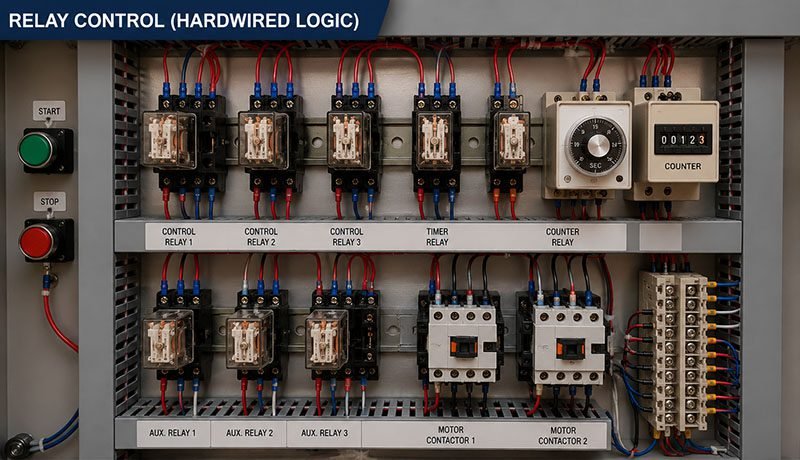
In a hardwired relay panel, the “program” is defined by the topography of the terminal blocks and the wire ducts. If you need a motor to start only when two pushbuttons are pressed, you wire two normally open contacts in series. To seal in the circuit (latching), you wire an auxiliary contact in parallel with the start button. The sequence of operations is executed simultaneously and instantaneously based on the physical laws of electromagnetism.
PLC Control (Soft Logic)
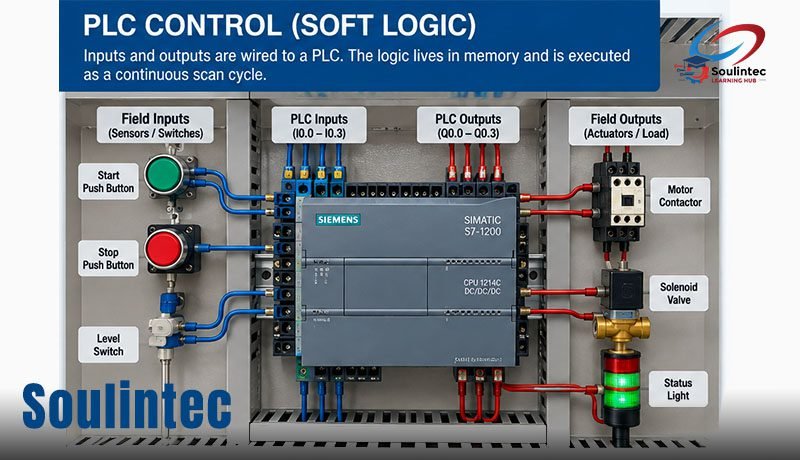
A PLC replaces the physical wiring of logic with a microprocessor. Inputs such as sensors and switches are wired to input cards, while outputs such as contactors, solenoids, and lights are wired to output cards. The logic lives in memory and is executed as a continuous scan cycle.
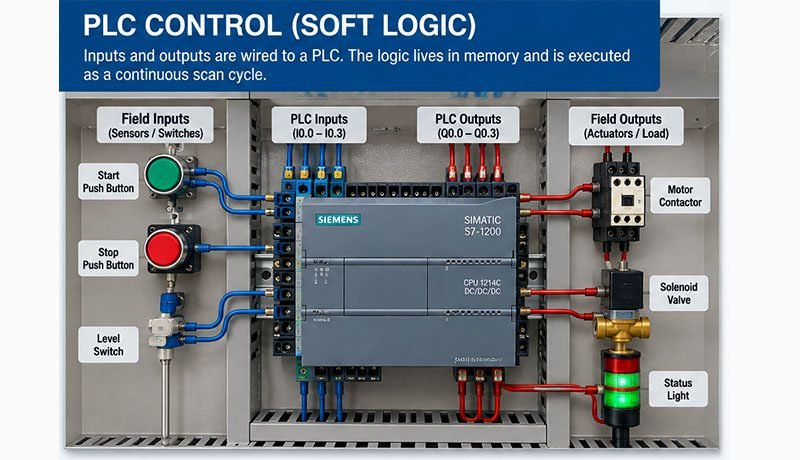
This is the critical distinction: a PLC does not operate continuously. It operates in a loop:
Read Inputs → Execute Program Logic → Write Outputs → Housekeeping
This scan time is typically measured in milliseconds. For most discrete manufacturing, this latency is negligible. However, in high-speed applications, scan time can become a limiting factor that a hardwired relay or a dedicated high-speed counter module must address.
Comparative Analysis: The Deciding Factors
1. Complexity and Logic Density
The primary driver for selecting a PLC over a relay panel is logic density.
Relay:
If your logic requires 50 relays, 20 timers, and 10 counters, a relay panel becomes a physical monster. Timers and counters in the relay world are discrete hardware devices that add significant cost and failure points. Troubleshooting a complex interlock involving 100 physical contacts requires a multimeter, a wiring schematic, and considerable troubleshooting time.
PLC:
A single Micro-PLC, such as a Siemens S7-1200 or Allen-Bradley Micro820, can replace a cabinet filled with numerous relays, timers, and counters while occupying a fraction of the physical space. The logic is rendered in Ladder Diagram or Function Block Diagram on a screen, where debugging can be done by monitoring the state of virtual bits rather than physically tracing every contact.
2. Speed and High-Frequency Operations
Relay:
Electromechanical relays have a physical switching time. While this may seem fast to a human operator, it becomes significant in high-speed electrical applications. If a process requires switching faster than the mechanical contacts can reliably operate, contacts can arc, weld, or miss pulses.
PLC:
Although the PLC scan cycle introduces a delay, solid-state outputs such as transistors and TRIACs allow high-frequency switching, PWM, and high-speed counting that mechanical relays cannot handle. Applications involving servo drives or high-speed feedback require appropriate PLC and motion-control technology.
3. Cost Analysis: CAPEX vs. Total Cost of Ownership
Relay:
The per-unit cost of a relay is low. For a machine with only a few I/O points, a relay panel can be significantly cheaper than a PLC.
However, the hardware price alone does not tell the full story. Every relay requires wiring, terminal blocks, ducting, panel space, documentation, and engineering labor. These additional costs can quickly become significant.
PLC:
The initial hardware cost is higher. However, as the control system becomes more complex, the cost advantage can quickly shift toward the PLC.
Adding another section of PLC logic does not require another physical relay, terminal, wire, or panel space. Furthermore, if the machine logic changes during commissioning, modifying PLC software is dramatically easier than rewiring a hardwired relay panel.
4. Diagnostics and Maintenance
This is where the PLC has a major advantage in an industrial environment.
Relay:
When a relay panel fails, the maintenance electrician must inspect the cabinet, consult the electrical drawings, and physically trace the voltage path to identify the failed relay, contact, wire, or connection.
PLC:
The PLC can provide extensive diagnostic information. A blown input fuse, tripped overload, missing permissive, or incorrect input condition can often be identified through PLC diagnostics, HMI messages, or status indicators.
The control program can also help engineers identify exactly which condition is preventing a sequence from continuing.
5. Environmental Robustness and Reliability
Relay:
Relays are electrically robust and can be used for switching motor starters, solenoid valves, and other loads when correctly selected and protected.
PLC:
PLCs contain sensitive electronic components and require appropriate power quality, grounding, shielding, installation, and environmental conditions. Modern industrial PLCs, however, are specifically designed for industrial environments and can provide excellent reliability when correctly installed.
The key point is that neither technology should be selected without considering the actual electrical environment and application requirements.
The Decision Matrix: When to Use What
Based on field experience, the following criteria can help determine whether relay control or PLC control is more appropriate.
Choose Relay Control If:
- Fixed, Simple Logic
The machine performs a simple function that is unlikely to change over its operational lifetime.
Examples include a simple conveyor start/stop circuit, sump pump float control, or lighting contactor panel.
- Extremely Low I/O Count
If the application requires only a very small number of inputs and outputs, the cost of a PLC, power supply, enclosure, and programming may exceed the cost of a few relays.
- Fail-Safe and Safety Circuits
Dedicated hardwired safety relays are still widely used for applications such as emergency stops and safety devices. Safety PLCs also exist, but the appropriate solution depends on the required safety architecture and applicable standards.
- Harsh Electrical Environments
In electrically noisy environments, proper protection, grounding, shielding, filtering, and installation are essential for PLC systems. Simpler relay-based control can sometimes be advantageous when electronic control is unnecessary.
Choose a PLC If:
- Complex Sequencing
If the process has multiple states such as Start, Fill, Heat, Agitate, and Discharge, PLC sequencing logic is far more manageable than a large network of interlocking relays.
- Data Collection and Communication
If you need to communicate with a SCADA system, record production data, monitor machine status, or communicate through industrial Ethernet or Modbus TCP, a PLC provides the necessary digital infrastructure.
- Future Flexibility
If the client is likely to change product recipes, machine speeds, sequences, or features, a PLC provides significantly greater flexibility because the control logic can be modified through software.
- Space Constraints
When cabinet or electrical-room space is limited, a PLC can replace a large amount of physical relay hardware.
The Hybrid Reality: The Interposing Relay
It is important to understand that industrial control systems are rarely purely PLC-based or purely relay-based.
In many modern control panels, the PLC is the brain and the relay is the interface between the control system and the field equipment.
A PLC output card may be used to energize a small interposing relay, while the relay contacts switch a higher-voltage or higher-current load.
This approach provides electrical isolation and allows the PLC output to control loads that may exceed the output card’s direct switching capability.
Why Not Just Use a Transistor Output?
Transistor outputs are solid-state devices with no moving parts. However, they can have leakage current when switched off. In certain applications, this leakage can cause problems with sensitive or high-impedance inputs.
A mechanical relay can provide galvanic isolation between the PLC output circuit and the controlled load.
Conclusion
In professional industrial automation, the relay should not be viewed as an outdated technology and the PLC should not automatically be viewed as the answer to every control problem.
A simple pump alternator or straightforward motor control circuit may be better served by conventional relay logic when the application is fixed, simple, and cost-sensitive.
On the other hand, a modern packaging line with servo axes, vision systems, recipe management, communication networks, and OEE monitoring requires the flexibility and processing capabilities of a PLC.
The art of electrical engineering lies not in choosing the newest technology, but in choosing the correct technology that balances reliability, maintainability, and cost.
Use relays when the logic is physical. Use a PLC when the logic is intellectual.
Ready to Move From Electrical Control Theory to Real PLC Skills?
If you are an Electrical Engineering student, recent graduate, Electrical Engineer, Automation Engineer, Maintenance Engineer, or Panel Builder, our hands-on PLC training is designed to help you build practical skills you can use in real industrial applications.
Learn PLC hardware and architecture, I/O configuration, Ladder Logic programming, timers and counters, motor control, troubleshooting, communication, and PLC commissioning through practical industrial training.
Start building the skills required for a career in Industrial Automation.
Enroll in the PLC Programming & Industrial Automation Hands-On Course:
For enrollment and course details:
Soulintec Learning Hub
Hands-on training for real industrial skills.