


PLC vs SCADA : Which You Learn First?
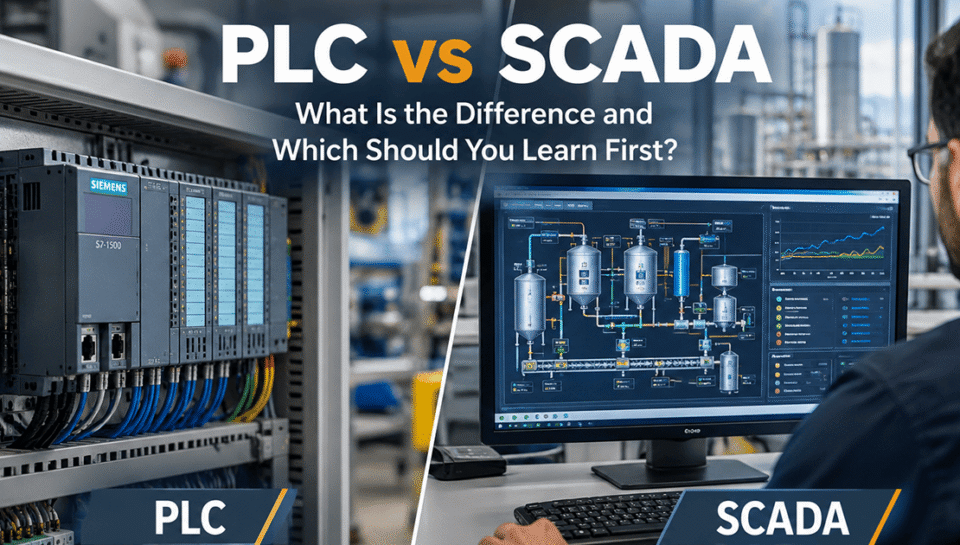
PLC vs SCADA: What Is the Difference and Which Should You Learn First?
If you’re entering industrial automation, one question comes up more than any other: should I learn PLC or SCADA first? Job postings often list “PLC SCADA Engineer” as if they’re one skill, but they are distinct disciplines with different tools, different daily work, and a clear learning order that most hiring managers expect you to follow.
What a PLC Actually Does
A Programmable Logic Controller (PLC) is the brain of the machine. It’s a ruggedized industrial computer wired directly to physical sensors and actuators, reading inputs every few milliseconds, executing a program written by an engineer, and switching outputs accordingly. A typical scan cycle takes 10 to 50 milliseconds and does four things: read inputs, execute logic, update outputs, and handle communications and diagnostics.
The PLC handles the “if-then” scenarios. If a sensor detects that a bottle is full, the PLC stops the pump immediately. PLCs are built for harsh environments—a Siemens S7-1500 operates from minus 25 to plus 60 degrees Celsius and runs for years without restart. Common platforms include Siemens (TIA Portal), Allen-Bradley/Rockwell (Studio 5000), Mitsubishi, Omron, and Schneider Modicon.
What SCADA Actually Does
SCADA (Supervisory Control and Data Acquisition) is the eyes and record-keeper of the plant. It’s a software-based control framework that sits above the PLCs, collecting data from them and other hardware across a facility. SCADA software runs on a server or panel PC and connects to PLCs over industrial protocols like OPC UA, Modbus TCP, EtherNet/IP, and PROFINET.

SCADA does five things PLCs cannot: visualization (animated graphical screens showing equipment status), alarming (configurable thresholds that trigger operator notifications), historian (long-term storage of process data for trending and reporting), recipe management (switching between product recipes without rewriting PLC code), and multi-site supervision (aggregating data from dozens or hundreds of locations into one operator desk). Common SCADA packages include Siemens WinCC, Rockwell FactoryTalk View, AVEVA Plant SCADA, Ignition by Inductive Automation, and Wonderware.
The Key Difference
The simplest way to frame it: PLC = action; SCADA = information. A PLC doesn’t care what an operator sees. A SCADA system doesn’t care about the scan cycle. They collaborate over a fieldbus, and each does one thing well.
A plant can run without SCADA if the PLC programs are correct. A plant cannot run without PLC even if SCADA is perfect. That hierarchy is the single most important concept to internalise before choosing where to start.
Which Should You Learn First?
Learn PLC first. Always. Here’s why:
SCADA makes no sense without PLC understanding. SCADA configuration depends on knowing what the PLC is doing—you tag PLC variables, display their values on HMI screens, and log their history. If you don’t understand how a PLC program works, SCADA is just a dashboard you’re connecting blindly. Students who learn SCADA first consistently struggle with tag structures, alarm logic, and troubleshooting.

Hiring expectations favour PLC depth. Interview questions for automation roles are roughly 70% PLC, 20% SCADA, and 10% networking. PLC programming is also harder and takes longer to master than SCADA configuration.
PLC skills transfer across vendors. Ladder logic concepts are universal. Once you understand one platform’s PLC programming, moving to another vendor is a matter of learning syntax, not relearning logic.
A combined skill set earns more. Combined PLC+SCADA engineers earn more than either specialist alone at entry level, and most small-to-mid plants hire one person to do both.
PLC vs. SCADA: Quick Comparison
| Feature | Programmable Logic Controller (PLC) | SCADA System |
| Primary Role | Direct machine control & real-time execution | Supervisory monitoring & data visualization |
| Type | Industrial Hardware (ruggedized controller) | Software application (runs on PC/Server/HMI) |
| Response Time | Milliseconds (10–50 ms scan cycle) | Seconds (human observation scale) |
| Location | Mounted on field panels near physical machinery | Control room desks, server racks, or cloud dashboards |
| Key Function | Executes logic, reads sensors, switches actuators | Long-term data logging, alarming, trending, & recipes |
| Common Software | Siemens TIA Portal, Studio 5000, EcoStruxure | Siemens WinCC, Ignition, FactoryTalk View, AVEVA |
A Practical Learning Path
A proven 16-week sequence: spend months 1–4 on PLC fundamentals—logic, I/O, sequencing, interlocks, and at least one IEC 61131-3 programming language (ladder logic, function block, or structured text). Add SCADA in months 5–6, focusing on HMI development, alarm philosophy, historian configuration, and SCADA architecture.

For self-study, Ignition’s free Maker edition is an excellent SCADA platform for first-time learners. Supplement with simulation software and small home projects—rebuilding a simple plant logic at home teaches more than waiting for a real change plan at work.
The Bottom Line
PLC and SCADA aren’t competing careers—they’re layered skills. Learn PLC first because it’s the foundation, the interview focus, and the skill that makes SCADA meaningful. Then add SCADA to become the complete automation engineer that plants actually hire.
At Soulintec Learning Hub, our PLC and SCADA courses follow exactly this sequence—hands-on PLC programming first, then SCADA configuration, with real project work throughout. Explore our automation courses to start your journey.
FAQ
1. Can a SCADA system replace a PLC?
No. SCADA software cannot directly control field hardware in real time. It lacks the millisecond scan speeds, determinism, and physical I/O connections required to operate machinery safely. SCADA relies on PLCs to execute local control logic while serving as the high-level interface for operators.
2. Is HMI the same thing as SCADA?
No, but they are related. An HMI (Human-Machine Interface) typically provides a local display screen for a single machine or small line. A SCADA system supervises an entire plant or multi-site facility, featuring advanced tools like long-term historical data logging, complex alarm routing, and multi-user access.
3. Which programming languages are used for PLC and SCADA?
- PLC Programming: Follows the IEC 61131-3 standard, using languages like Ladder Diagram (LD), Function Block Diagram (FBD), and Structured Text (ST).
- SCADA Development: Uses graphical drag-and-drop design alongside scripting languages like Python, VBScript, or JavaScript for custom animations, database queries, and reporting.
4. Do I need to learn PLC before SCADA?
Yes. Because SCADA systems read variables, tags, and data addresses generated by PLCs, attempting to learn SCADA first creates confusion. Mastering PLC logic gives you the foundational knowledge needed to configure SCADA screens, tag mapping, and alarm thresholds accurately.
5. What are the key industrial protocols connecting PLCs to SCADA?
PLCs and SCADA systems communicate over standard industrial networking protocols, including OPC UA, Modbus TCP, PROFINET, and EtherNet/IP.
Learn. Practice. Build. Troubleshoot.
Explore the available courses and training programs at:
Don’t wait until your first job to start learning how industrial automation works.
Start building the practical skills now, so when the opportunity comes, you are ready for it.